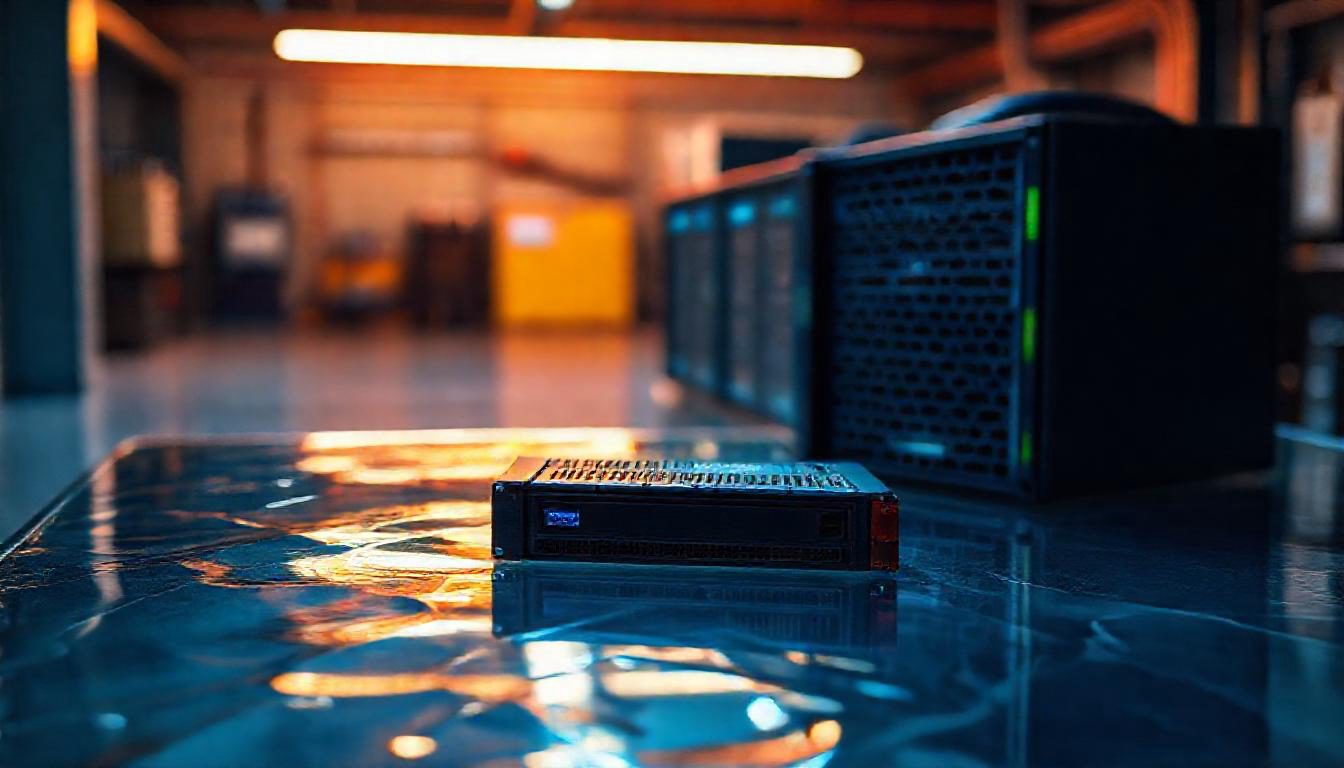
Phison Electronics has unveiled a solid-state drive that fundamentally breaks the traditional separation between storage and processing. The new device integrates a Neural Processing Unit (NPU) and 64GB of dedicated memory directly onto the drive, allowing it to execute artificial intelligence frameworks and complex queries locally. This move away from passive data repositories toward “Computational Storage SSD” architectures signals a pivotal shift in how U.S. data centers manage the explosive growth of AI workloads. By offloading inference tasks from the central CPU or GPU to the storage medium itself, Phison aims to reduce latency, minimize data movement, and lower overall power consumption. For American CTOs and infrastructure investors, this hardware evolution presents both an opportunity for efficiency and a challenge to existing procurement standards.
Computational Storage SSD: Mechanics of In-Drive AI
The core innovation lies in the architecture’s ability to process data where it resides. Traditional storage systems act as dumb pipes, moving raw bytes to a host processor for interpretation. Phison’s new drive, demonstrated at SC26, includes a specialized NPU capable of handling vector operations and tensor calculations essential for modern machine learning models. The inclusion of 64GB of on-drive memory allows for the caching of model weights and intermediate layers, significantly accelerating read/write operations during inference.
This setup is particularly relevant for retrieval-augmentation generation (RAG) pipelines, where databases must be queried frequently. By supporting major AI frameworks directly on the hardware, the drive can execute search and similarity matching tasks without interrupting the host server’s primary compute resources. Analysts estimate that this approach could reduce network congestion by up to 40% in high-density environments, as fewer raw data packets are shuttled between storage nodes and compute clusters.
Impact on Data Center Economics
For U.S. data center operators, the economic implications of computational storage are substantial. Electricity costs remain a primary concern, with power availability often constraining expansion in key hubs like Northern Virginia and Texas. By shifting computation to low-power NPU cores within the SSD, facilities can achieve higher throughput per watt compared to traditional Xeon or GPU-driven servers.
The hardware also promises to alleviate the memory bottleneck. Moving data from storage to DRAM and then to CPU registers is energy-intensive. Phison’s solution enables the SSD to return only the relevant processed results, not the raw data. This reduction in input/output (I/O) overhead translates directly into lower capital expenditures for networking gear, such as high-bandwidth switches and cables, which are often needed to feed data hungry processors.
Key Cost Drivers Affected
- Power Consumption: Lower TDP per terabyte of processed data.
- Networking Capex: Reduced need for high-speed interconnects between storage and compute nodes.
- Server Density: Each chassis can handle more parallel AI tasks without requiring additional GPU slots.
Read also: Supply Chain Attack Exposes Web Vulnerabilities · Drone Defense Markets: How Electronic Warfare Hardware Gains Value
Challenges for Enterprise Adoption
Despite the technical promise, widespread adoption of Phison’s drive faces significant hurdles. The primary concern for enterprise IT teams is software compatibility and vendor lock-in. Integrating a proprietary NPU requires specific drivers and middleware that may not align with standardized open-source AI ecosystems. If the drive’s firmware does not seamlessly support frameworks like PyTorch or TensorFlow, developers may struggle to leverage the hardware’s capabilities without extensive re-engineering.
Furthermore, the reliability of computational storage remains an open question. Adding complex logic to the storage layer increases the potential failure surface. If the NPU fails, does the data become inaccessible? Enterprise-grade SLAs (Service Level Agreements) will demand rigorous redundancy protocols before these drives gain traction in mission-critical financial and healthcare applications. U.S. investors should watch for certifications from major hyperscalers like Amazon Web Services or Microsoft Azure, as their adoption would validate the technology’s stability and security.
“The integration of compute into storage is not just a hardware upgrade; it is a fundamental re-architecture of the data center stack.”
Strategic Implications for U.S. Tech Supply Chains
This development also touches on broader supply chain dynamics. As American companies seek to reduce dependence on foreign manufacturing for critical infrastructure, the ability to integrate diverse components like NPUs and flash memory into single-source solutions becomes strategic. Phison, a Taiwan-based company, is leveraging its existing dominance in controller chips to expand its value proposition. For U.S. firms, this reinforces the need to monitor geopolitical risks associated with advanced packaging technologies.
Moreover, the rise of specialized AI hardware could shorten product life cycles. If storage devices become active computing nodes, they will require firmware updates and potential hardware replacements more frequently to keep pace with evolving AI models. This could disrupt current procurement models, which favor long-term, bulk purchases of commodity hardware with predictable depreciation schedules. CFOs may need to adjust capital allocation strategies to account for faster refresh rates in the storage sector.
Key Takeaways
- Phison’s new drive integrates an NPU and 64GB memory, enabling local AI processing.
- The technology reduces data movement, lowering power consumption and network load.
- Enterprise adoption depends on software compatibility with major AI frameworks.
- U.S. data centers may see shifted CapEx from networking to specialized storage hardware.
- Reliability and security certifications remain critical barriers to mass deployment.
Based on reporting by tomshardware.com.
FAQ
What is a computational storage SSD?
A computational storage SSD is a drive that includes processing capabilities, allowing it to perform data operations like filtering, searching, or AI inference locally rather than sending raw data to a host processor.
How does the NPU in Phison’s SSD benefit AI workloads?
The NPU accelerates matrix and vector calculations required for AI models, reducing latency and freeing up CPU/GPU resources for other tasks, which improves overall system efficiency.
Will this technology replace traditional GPUs in data centers?
Unlikely in the near term. It complements GPUs by handling data-heavy inference and search tasks, potentially reducing the load on GPUs but not replacing their role in heavy training and complex model execution.
Is the 64GB memory on the drive usable for general computing?
No, it is dedicated internal memory for the NPU to cache model weights and intermediate data. It is not accessible to the host operating system as standard RAM.

Comments (4)