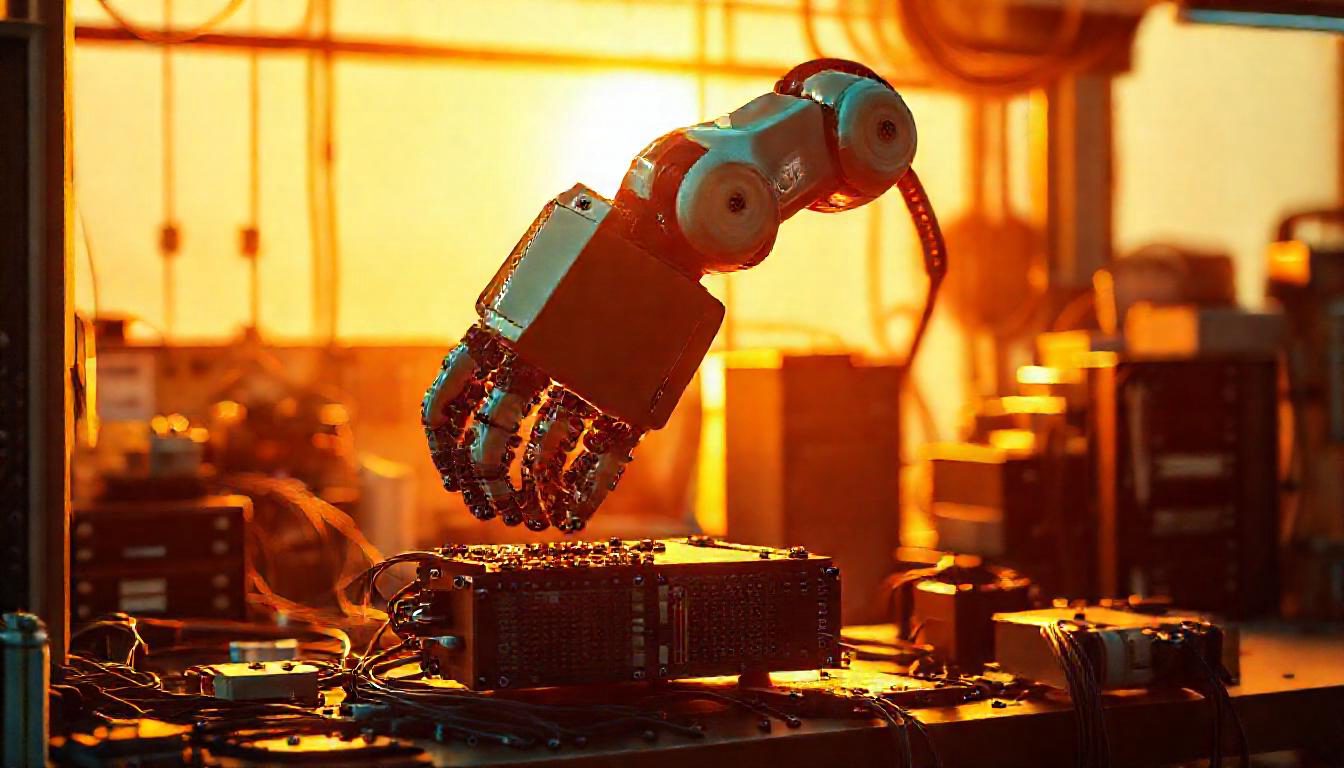
The last eighteen months have seen an unprecedented surge in capital allocation toward artificial intelligence, yet a stark divergence has emerged between the digital and physical realms. While software companies leverage Neural Network Actuation to automate coding, customer support, and financial modeling, industrial robotics remain largely tethered to human oversight. For U.S. entrepreneurs and investors, this discrepancy is not merely a technical hurdle but a fundamental marketing misalignment. The promise of autonomous labor—drivers, warehouse pickers, and construction assistants—is colliding with the unforgiving reality of physics, resulting in depressed returns on investment (ROI) for hardware-heavy AI ventures.
This analysis dissects why the transition from digital inference to physical action is so difficult, how regulatory pressures like the Federal AI Act impact deployment timelines, and what the current valuation gap implies for the next cycle of industrial automation.
The Gap Between Digital Logic and Neural Network Actuation
The core challenge lies in the fundamental difference between processing tokens and applying torque. In digital environments, Neural Network Actuation is forgiving; a minor error in a text generation or code completion task results in a corrected iteration. In the physical world, a marginal error in robotic actuation results in damaged goods, injured workers, or halted production lines.
Current large language models (LLMs) and vision-language-action (VLA) models excel at semantic understanding but struggle with high-frequency motor control. The latency required to process complex sensor data and translate it into precise motor commands remains a bottleneck. For manufacturing firms in the Rust Belt or logistics hubs in the South, the ROI on robotic arms that require constant human intervention to reset or dial in parameters is negative. The technology works in silos but fails in the chaotic, unstructured environments typical of American warehouses and job sites.
Why Simulation-to-Reality Transfer Fails
Investors often assume that Neural Network Actuation can be perfected in simulation before deployment. However, the sim-to-real gap is wider than anticipated. Physical friction, air resistance, and unexpected material deformities introduce variables that digital twins cannot perfectly predict. Consequently, companies spend significant capital retraining models on-site, eroding the cost savings that automation was supposed to guarantee.

Regulatory Friction and the Federal AI Act
Heading into Q2 of 2026, the regulatory landscape has become a critical variable in the robotics ROI equation. The Federal AI Act, which emphasizes transparency and safety for high-risk systems, has imposed stringent documentation requirements on autonomous physical agents. Unlike software patches, hardware recalls are exponentially more expensive and damaging to brand reputation.
The Act categorizes autonomous robotics as high-stakes systems, requiring rigorous pre-deployment testing and post-deployment monitoring. For startups, this compliance burden delays time-to-market by 12 to 18 months. For established players like Caterpillar or John Deere, it increases operational overhead. This regulatory friction slows down the iterative cycle necessary for Neural Network Actuation to improve, creating a feedback loop where slower deployment leads to stagnant data collection, which in turn hampers model refinement.
The cost of compliance is no longer just legal fees; it is the opportunity cost of delayed market entry in a sector where first-mover advantage dictates long-term profitability.
Labor Economics and the Defense of Human Wages
A critical mispriced risk in the AI robotics boom is the assumption that automation will universally replace labor due to cost differentials. In reality, the U.S. labor market is bifurcated. While there is a shortage of skilled tradespeople, there is a surplus of low-wage, flexible labor in many sectors. Neural Network Actuation currently offers a value proposition primarily in hazardous or repetitive tasks, not general-purpose labor.
The ROI for replacing a $20/hour warehouse worker with a $100,000 robot that requires a $50/hour technician for maintenance is mathematically unsound for most small and mid-sized enterprises (SMBs). The break-even point for robotic deployment has shifted further out than optimistic venture capital models suggest. This reality check is forcing a pivot from “full autonomy” to “cobotic” (collaborative) models, where the robot assists rather than replaces. This hybrid approach is safer and more compliant, but it yields lower labor savings, dampening the projected cash flows for tech providers.
The Valuation Correction in Physical AI
Market analysts are beginning to price in the actuation lag. While pure-play software AI companies trade at high multiples based on scalable margins, robotics firms are seeing compressed valuation multiples. The capital intensity of hardware, combined with the slower revenue recognition cycles due to lengthy pilot programs, makes these businesses less attractive to growth funds.
Investors are rotating capital toward the “picks and shovels” of physical AI—sensor fusion chips, advanced materials, and energy-efficient actuators—rather than betting on specific robot applications. The risk is no longer whether the AI can think, but whether the machine can move efficiently and safely enough to justify the price tag.
Key Takeaways
- Latency is the Enemy: The time delay between Neural Network Actuation decisions and physical execution remains the primary technical barrier to profitable automation in unstructured environments.
- Regulation Slows Iteration: The Federal AI Act has increased the cost and duration of pre-deployment testing, delaying the market entry for new robotic systems by up to 18 months.
- Labor Arbitrage is Fading: The ROI on replacing low-wage labor with high-capex robotics is negative for most SMBs; the market is shifting toward collaborative assistance rather than total replacement.
- Valuation Divergence: Physical AI companies are seeing compressed valuations compared to software-only AI, with investors favoring component suppliers over full-stack robotics integrators.
For official data and guidance on this topic, see OECD.AI Policy Observatory.
FAQ
Why is Neural Network Actuation harder than software automation?
Physical environments are unstructured and chaotic, requiring precise, high-frequency motor control where errors result in physical damage or safety hazards, unlike the easy-to-correct nature of digital outputs.
How does the Federal AI Act impact robotics startups?
The Act classifies autonomous robots as high-risk systems, mandating extensive documentation and testing that delays deployment cycles by 12 to 18 months, significantly increasing pre-revenue burn rates.
Is the ROI for warehouse robotics currently positive?
For most small and mid-sized businesses, the ROI is negative due to high capital expenditure and maintenance costs. Positive returns are currently limited to large-scale, highly structured logistics hubs with massive volume throughput.



Comments (3)