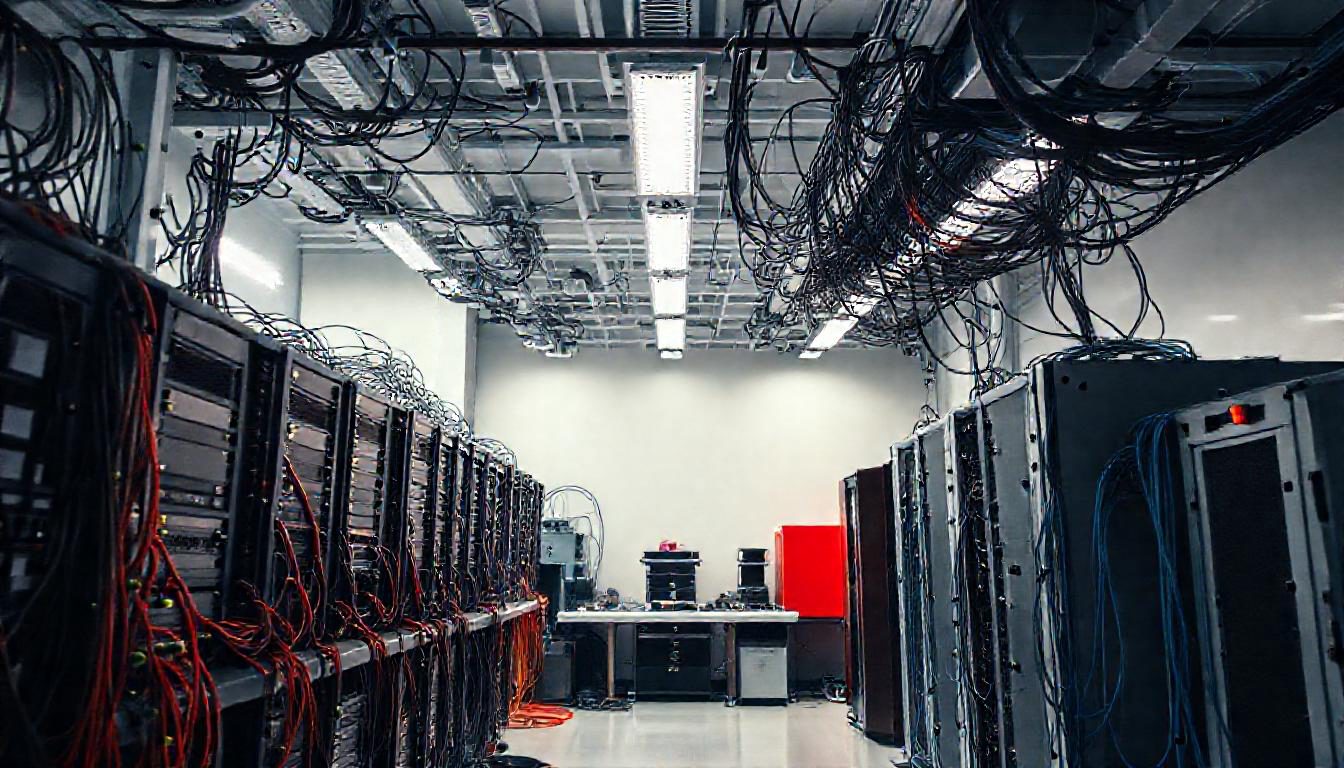
The era of buying GPUs and hoping for the best is over. For neocloud providers and enterprise buyers, the primary constraint on AI hardware scaling has shifted from raw compute availability to the efficiency of the internal plumbing. By mid-2026, the marginal return on adding more H100s and Blackwell chips has collapsed for operators who failed to upgrade their network fabric and memory interconnects. This isn’t just a technical footnote; it’s a balance sheet crisis. The cost per FLOP for many U.S. neoclouds has effectively risen because 30 to 40 percent of their system time is spent waiting for data to move between chips, a problem defined by AI fabric latency. Investors looking at the sector’s gross margins must now distinguish between providers who have solved the interconnect bottleneck and those who have not. The difference in EBITDA margins can be as large as 15 percentage points, a variance that determines whether a company survives the next capital cycle or dilutes its shareholders to pay for it.
The Interconnect Bottleneck in AI Hardware Scaling
For the past three years, the narrative of AI hardware scaling centered on scarcity. If you could get your hands on NVIDIA’s latest accelerators, you won. That scarcity premium is fading as supply chains stabilize and foundry capacity increases. But scarcity has simply moved downstream. The issue now is communication. Modern large language models are so massive that they cannot fit on a single device. They must be sharded across dozens or hundreds of GPUs. Every time these chips need to synchronize their gradients, they rely on NVLink and InfiniBand protocols. If the bandwidth is insufficient or the AI fabric latency is too high, the expensive compute units sit idle.
This has created a paradox for the U.S. tech sector. Companies are spending billions on accelerators that are effectively underutilized. The focus keyword AI hardware scaling encapsulates this struggle: you can scale the compute, but you cannot scale the training efficiency if the network fabric is outdated. Neocloud providers who purchased Gen 4 infrastructure without upgrading their switches to Gen 5 standards are finding themselves locked into high-performance, low-utility systems. They are paying electricity and cooling costs for silicon that spends half its day communicating rather than calculating.
Why AI Fabric Latency Determines Margins
The economics of AI hardware scaling are driven by utilization rates. When a cluster runs at 90 percent efficiency, the cost per token generated is profitable. When the same cluster runs at 60 percent efficiency due to network stalls, the cost per token doubles without any change in capital expenditure. This is where the neocloud model fractures. Traditional cloud providers like AWS and Azure have vertically integrated their networking solutions, often building their own switches and protocols (such as EFA or RDNA) to optimize this flow.
Neocloud providers who purchased Gen 4 infrastructure without upgrading their switches are finding themselves locked into high-performance, low-utility systems.
Independent neoclouds, however, operate on thinner margins. They rely on merchant silicon and generic networking gear. As the gradient synchronization requirements for frontier models increase, the gap between optimized fabric and generic fabric widens. Investors need to look beyond the total number of GPUs in a data center. The critical metric is the “bisection bandwidth” per square foot of rack space. A provider with 10,000 GPUs might have inferior throughput compared to a provider with 5,000 GPUs if the latter has a superior optical interconnect architecture. The capital efficiency of AI hardware scaling is no longer about who has the most chips, but who has the fastest pipes, minimizing AI fabric latency.
Read also: B200 Yield Rates: How Packaging Limits Drive AI Hardware Bids · Neocloud Obsolescence: How GPU Shelf Life Hits Margins
The Shift from Copper to Optical
Scaling up requires moving beyond the reach of passive copper cables. For clusters that need to span multiple rows or racks, copper becomes too heavy and too lossy. This has accelerated the adoption of co-packaged optics and linear-drive pluggable optics (LPO). While these technologies reduce power consumption at the port level, they introduce new failure modes and strict manufacturing tolerances.
The transition to optical fabrics in AI hardware scaling is expensive. It requires not just new transceivers, but a complete redesign of the data center’s thermal profile. Optics are more sensitive to temperature fluctuations than copper. If a neocloud provider skimps on liquid cooling precision, their optical link error rates spike, causing retransmissions that grind training jobs to a halt. We are seeing a wave of write-downs in the sector as operators realize their generic air-cooled racks cannot support the optical interconnects required for the next generation of models. This is a physical manufacturing limit that software cannot code around. The shift to optical is mandatory for AI hardware scaling, but it is a capital-intensive project that many mid-tier neoclouds cannot finance without diluting their equity, especially when AI fabric latency remains high.
Memory Interconnects and the Roofline Model
It’s not just the network between GPUs; it’s the link between the GPU and its memory. High Bandwidth Memory (HBM) has become a microcosm of the larger interconnect crisis. As HBM stacks grow larger, the physical distance between the memory controller and the compute core increases. This raises AI fabric latency. The industry’s response has been to integrate the memory closer to the logic, leading to the adoption of 3D stacking and advanced packaging techniques like TSMC’s CoWoS.
For enterprises buying hardware, this complicates the procurement process. You cannot simply buy “more memory.” You must buy memory that is architecturally compatible with the compute die’s interconnect logic. A mismatch between the HBM generation and the GPU’s internal bus width results in a system that is theoretically powerful but practically sluggish. This architectural coupling means that AI hardware scaling is becoming less modular. You are no longer buying components; you are buying a single, monolithic supercomputer built from a specific foundry’s roadmap. If you miss a slot in the packaging process, you miss the entire generation, creating a 12-to-18-month delay in your time-to-market. This risk is now priced into the cap tables of hardware startups.
Key Takeaways
- Utilization is the new metric: Total GPU count is irrelevant if network stalls reduce effective training time by 30 percent.
- Optical mandates cooling upgrades: Co-packaged optics require precision liquid cooling; air-cooled racks are becoming obsolete for high-scale AI.
- Vertical integration wins: Neoclouds without custom networking silicon face structurally higher costs per token.
- Modularity is ending: Advanced packaging couples memory and compute, making hardware upgrades all-or-nothing decisions.
For official data and guidance on this topic, see Semiconductor Industry Association.
FAQ
What is the biggest bottleneck for AI hardware scaling in 2026?
The biggest bottleneck is no longer chip supply, but network interconnect bandwidth. The speed at which data moves between GPUs and memory is limiting the efficiency of large compute clusters, specifically regarding AI fabric latency.
How does the interconnect bottleneck affect neocloud profitability?
When the network is slow, expensive GPUs sit idle waiting for data. This lowers utilization rates, which dramatically increases the cost per token generated, shrinking gross margins and making it harder to compete with hyperscalers.
Why are optically connected racks more expensive to maintain?
Optical transceivers are sensitive to heat and vibration. They require precision liquid cooling systems to maintain signal integrity, which increases both the initial capital expenditure and the operational complexity compared to standard copper-based racks, impacting AI fabric latency.


Comments (2)