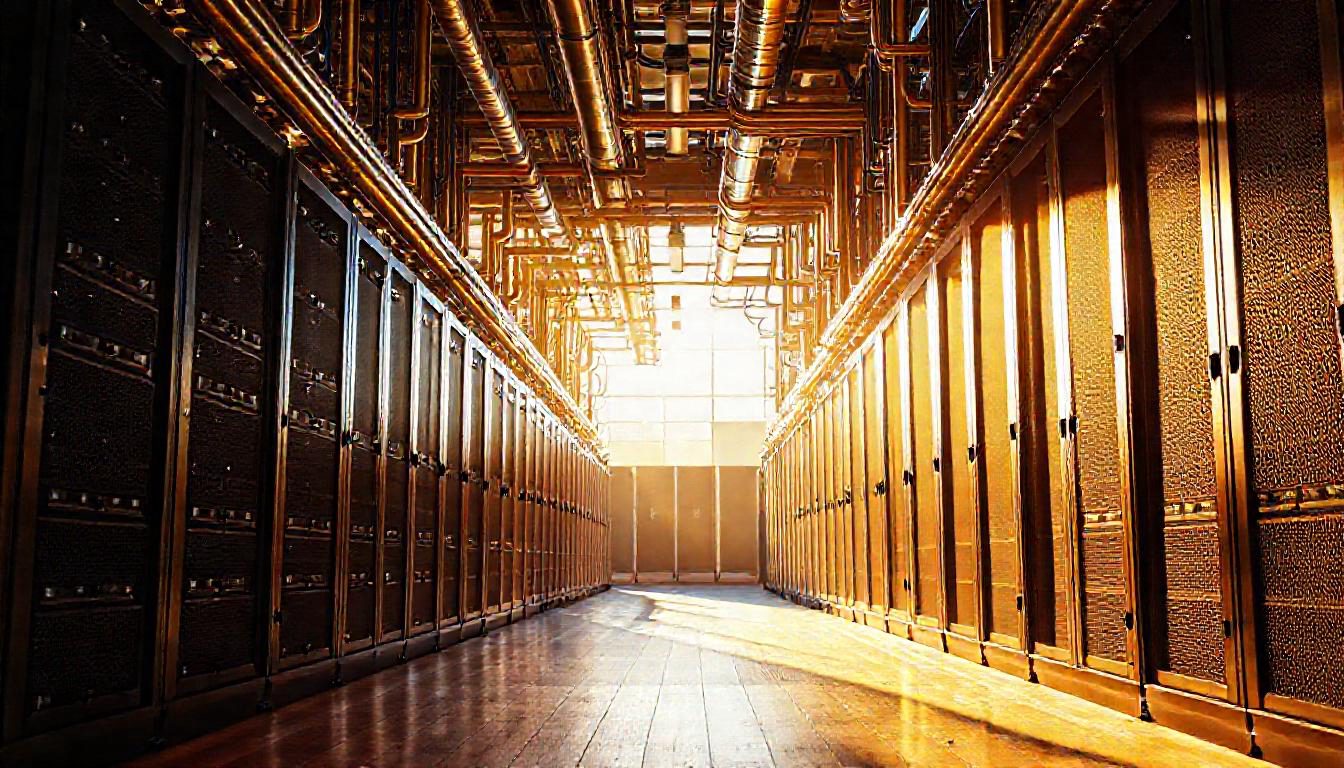
The trajectory of AI hardware power density has collided with a hard physical wall: air cooling. As rack-level wattage climbs, traditional HVAC systems can no longer dissipate heat efficiently, turning Data Center Cooling Costs into the primary driver of operational expense fluctuations. For U.S. operators and investors, the transition from air-cooled facilities to liquid-cooled infrastructure now impacts the bottom line far less than it impacts physical feasibility.
Why Air Cooling Is No Longer Sustainable
Modern AI accelerators, particularly those designed for large language model inference and training, generate heat fluxes that exceed the capacity of standard CRAC (Computer Room Air Conditioning) units. When rack density surpasses 40-50 kilowatts, air cooling requires excessive fan speeds, driving up power usage effectiveness (PUE) and creating mechanical vibration issues. The inefficiency isn’t just a minor cost; it is a structural barrier to scaling.
Liquid cooling offers a thermal conductivity advantage of roughly 3,500 times that of air. By moving heat directly from the chip to a coolant via cold plates or immersion tanks, operators can reduce cooling energy consumption by 10% to 20% relative to air-cooled baselines. This shift fundamentally alters Data Center Cooling Costs, replacing variable air handling expenses with higher upfront capital expenditures (CapEx) for fluid distribution infrastructure.
Managing Data Center Cooling Costs in Infrastructure
For capital allocators, the choice between direct-to-chip liquid cooling and immersion cooling represents a distinct risk profile. Direct-to-chip is incremental and compatible with many existing data center shells, whereas immersion requires specialized tanks and dielectric fluids, demanding a greenfield or heavy retrofit approach.
Key considerations for 2026 budgeting include:
- CapEx vs. OpEx Trade-offs: Liquid cooling raises initial deployment costs but lowers long-term energy demand.
- Maintenance Complexity: Fluid pumps and leak detection systems require specialized technician training, unlike standard HVAC maintenance.
- Water Usage: Closed-loop systems reduce water consumption significantly compared to evaporative air cooling, a critical metric for arid U.S. regions like Arizona and Texas.
Operators shifting to liquid infrastructure report 30% reductions in cooling energy use, but face a 15% increase in maintenance labor costs due to the specialized nature of fluid handling.
How Will This Impact U.S. Growth?
The move toward liquid cooling accelerates the construction of high-density AI data centers. Investors should anticipate that facilities adopting these technologies will command higher premiums and longer lease terms, as they meet the thermal requirements of next-generation hardware. Failing to assess Data Center Cooling Costs through this lens risks underestimating the operational stability of high-performance computing assets.
For official data and guidance on this topic, see IEEE Spectrum.
Key Takeaways
- Physical Limits: Air cooling cannot support modern high-density AI racks, forcing a technological shift to liquid solutions.
- Cost Structure: Liquid cooling increases upfront CapEx but stabilizes rising energy costs and improves PUE efficiency.
- Strategic Choice: Operators must decide between direct-to-chip (retrofit-friendly) and immersion (high-performance but complex) based on facility type and growth timeline.
- Investor Value: Facilities with liquid infrastructure are positioned to retain anchor tenants demanding high-density compute.

Comments (2)