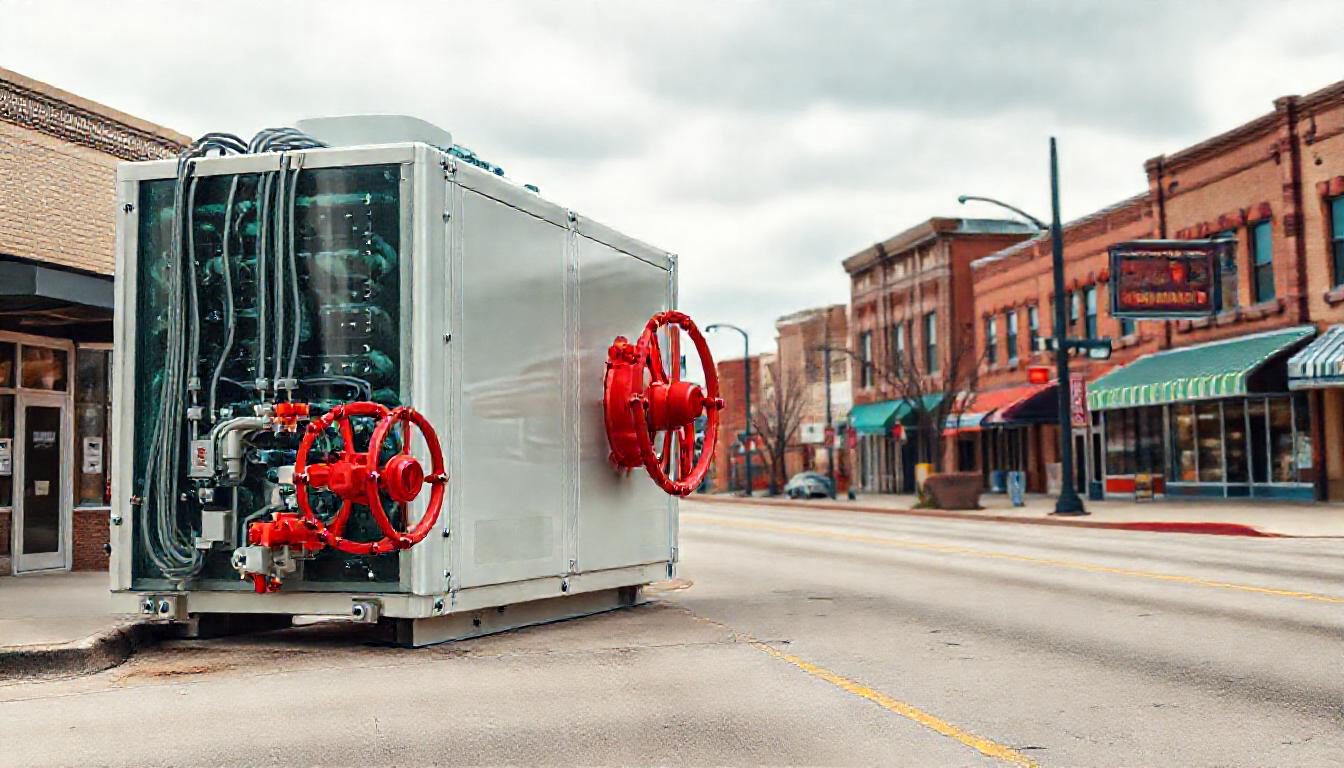
The era of treating AI data center cooling as a mere facilities overhead is over. At this point, thermal management is the primary constraint on hardware investment returns. For U.S. investors and operators, the shift from air to liquid cooling is not just an engineering challenge; it is a capital allocation imperative. As we head into the fourth quarter of 2026, the divergence between companies mastering this transition and those stuck with obsolete infrastructure is widening, directly impacting asset lifespans and power purchase agreements (PPAs).
Why Air Cooling Hits a Wall
Legacy data centers rely on Computer Room Air Conditioning (CRAC) units to blow cold air through hot aisles. This method worked well when server racks drew 10–15 kilowatts. Today, high-density AI racks equipped with next-generation accelerators consume 50 to 100 kilowatts or more. Air simply cannot transfer heat away from these components fast enough without requiring massive, energy-intensive airflow that reduces hardware reliability through vibration and dust ingress.
The physics are unforgiving. The specific heat capacity of air is roughly 1,000 times lower than that of liquid water. Trying to cool a 100kW rack with air requires wind speeds that cause acoustic noise levels intolerable for precision fans, leading to premature bearing failure and increased Mean Time Between Failures (MTBF) for the servers themselves. For investors, this means lower uptime SLAs (Service Level Agreements) and higher maintenance CapEx.
The Liquid Shift: Direct-to-Chip vs. Immersion
Two primary liquid cooling strategies are currently scaling across U.S. hyper-scalers and colocation facilities: Direct-to-Chip (DTC) liquid cooling and Immersion Cooling.
Direct-to-Chip Coooling DTC involves mounting cold plates directly onto the CPU and TDP (Thermal Design Power) GPUs. Coolant (usually a water-glycol mixture) flows through these plates, absorbing heat before moving to a rear-door heat exchanger or a facility-wide CDU (Coolant Distribution Unit). This approach is modular, allowing operators to retrofit existing racks gradually. However, it requires rigorous quality control on manifold connections to prevent leaks, which are catastrophic for electronics.
Immersion Cooling Immersion cooling submerges the entire server in a dielectric fluid. This fluid is non-conductive, allowing servers to operate safely while the liquid absorbs heat directly from every component, including memory and VRMs. There are two types:
- Single-Phase: The fluid remains liquid. Heat is transferred to a heat exchanger. This is simpler but less efficient at extreme densities.
- Two-Phase: The fluid boils off the chip surface, condenses on the tank lid, and falls back. This method offers the highest thermal efficiency but requires phase-change engineering and sealed tanks.
Financial Implications for Investors
Understanding the hardware lifecycle economics of these systems is critical for valuation models.
| Feature | Air Cooling | Direct-to-Chip | Immersion |
|---|---|---|---|
| Max Rack Density | ~20 kW | ~50-80 kW | >100 kW |
| Power Efficiency (PUE) | 1.4 – 1.6 | 1.1 – 1.2 | 1.02 – 1.08 |
| Hardware Lifespan | Standard | Extended | Significantly Extended |
| Upfront CapEx | Low | Medium | High |
| Maintenance Risk | Low | Medium (Leaks) | Low (No Fans/Moving Parts) |
“In the AI hardware market, thermal efficiency is no longer just about electricity bills; it is about asset preservation. The hardware itself is the most expensive component, and protecting it from thermal degradation is the highest-yield investment.”
For private equity firms and infrastructure funds, the PUE (Power Usage Effectiveness) metric is a direct proxy for operational expenditure (OpEx) sustainability. A data center with a PUE of 1.5 wastes 50% of its energy on cooling. A facility with a PUE of 1.1 wastes only 10%. Over a ten-year contract, this difference creates a multi-million dollar gap in net operating income (NOI). Furthermore, immersion cooling drastically reduces hardware failure rates because there are no fans to fail and no thermal cycling to crack solder joints. This extends the useful life of expensive GPUs, delaying replacement CapEx and improving IRR (Internal Rate of Return) on hardware-heavy portfolios.
Regulatory and Grid Constraints
The Federal Energy Regulatory Commission (FERC) and local U.S. utilities are increasingly scrutinizing high-energy data centers. In regions like Northern Virginia and Central Texas, grid capacity is tightly constrained. Operators who can demonstrate lower water and energy consumption per compute unit are more likely to secure favorable interconnection agreements and avoid punitive demand charges.
Generally, U.S. state-level sustainability mandates favor liquid cooling because it eliminates the need for evaporative cooling in many climates, conserving water resources. This is particularly critical in drought-prone areas like the Southwest. Investors should favor companies that disclose their Water Usage Effectiveness (WUE) alongside PUE, as this data increasingly influences ESG (Environmental, Social, and Governance) ratings and access to green bonds.
Strategic Takeaways for 2026
As the hardware cycle accelerates with the rollout of next-generation accelerators, the cooling infrastructure must keep pace. Companies that bet on air-cooled fleets for AI workloads will face severe throttling constraints, where GPUs intentionally downclock to protect themselves from heat, rendering the hardware inefficient.
For entrepreneurs building AI startups, selecting infrastructure providers with mature liquid cooling stacks is a risk-mitigation strategy. It ensures predictable latency and sustained performance. For hardware vendors, offering integrated cooling solutions rather than just bare chips is becoming a key differentiator. The trend is clear: the compute unit and the thermal unit are no longer separate procurement decisions; they are a single, integrated system purchase.
Key Takeaways
- Thermal Density is the New Bottleneck: Traditional air cooling is physically insufficient for racks exceeding 30kW, making liquid cooling mandatory for most modern AI deployments.
- PUE Drives Valuation: Lower Power Usage Effectiveness achieved through immersion or direct-to-chip cooling significantly reduces OpEx, improving net operating income and asset valuation.
- Hardware Longevity: Liquid cooling, particularly immersion, extends the useful life of expensive GPU assets by eliminating thermal stress and fan failures.
- Regulatory Advantage: Efficient cooling helps secure grid interconnections in constrained U.S. markets and aligns with ESG mandates regarding water and energy usage.
- Integrated Procurement: Investors should prioritize infrastructure vendors who offer bundled compute and cooling solutions to avoid compatibility risks and performance throttling.
Read also: LPDDR5X vs GDDR7: Investing in Memory for AI Hardware · 18A Node Yield: How Intel’s 2026 Chip Revival Impacts U.S. Supply Chains
For official data and guidance on this topic, see IEEE Spectrum.
FAQ on AI data center cooling
What is the main difference between Direct-to-Chip and Immersion cooling?
Direct-to-Chip cools only the processors using cold plates, allowing for modular upgrades, while Immersion fills the entire server with dielectric fluid, offering superior cooling for all components but requiring specialized tank infrastructure.
Does liquid cooling save money on electricity bills?
Yes, significantly. By reducing the energy needed to run fans and chillers, liquid cooling lowers Power Usage Effectiveness (PUE). However, the return on investment depends on the scale of the deployment and the cost of electricity in the specific region.
Is immersion cooling safe for standard hardware warranties?
Many manufacturers now approve immersion for specific servers, but it voids standard warranties if the hardware was not designed for it. Operators must verify warranty terms with vendors like Nvidia, AMD, or Intel before retrofitting existing fleets.
How does this affect data center location choices?
High-efficiency cooling allows data centers to operate closer to dense urban centers with limited grid capacity, as they consume less power and generate less waste heat. This expands viable locations beyond traditional rural industrial zones.
Comments (3)